Introduction↑
Background
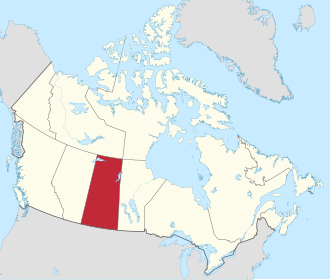
Saskatchewan is a western Canadian prairie province known for its vast open skies, golden wheat fields, and incredible natural resources. It is uniquely shaped as a geometric quadrangle with borders meeting at straight lines. Its capital city is Regina, and its largest city is Saskatoon, known as the "Bridge City."
Geography↑
Land and Water
Saskatchewan's landscape is famous for its dramatic split: the southern half is dominated by flat, fertile prairie farmlands and rolling plains, while the northern half transitions into rugged Canadian Shield terrain filled with thick boreal forests and tens of thousands of pristine freshwater lakes.
Location: Western Canada / Prairie Provinces
Geographic coordinates: 49°00′ N to 60°00′ N, 101°22′ W to 110°00′ W
Area: total: 251,700 sq mi (651,900 km2) | land: 227,800 sq mi (591,670 km2) | water: 23,900 sq mi (60,230 km2) | coastline: none (landlocked)
Bordering Regions: Alberta, Manitoba, Northwest Territories, United States (Montana, North Dakota)
Elevation extremes: lowest point: Lake Athabasca shoreline at 699 ft (213 m) | highest point: Cypress Hills at 4,547 ft (1,392 m)
Population↑
Demographics
Population: 1,240,000 (2026 estimate)
Largest City: Saskatoon: 275,000 (Regina: 235,000)
Age structure: 0-14 years: ~20.0% | 15-64 years: ~63.0% | 65 years and over: ~17.0% | Male: 49.8% | Female: 50.2%
Population growth rate: ~1.6% annually
Population density: 5.4 per sq mi (2.1 per sq km)
History↑
First Nations and the Fur Trade
For thousands of years, Saskatchewan was home to Indigenous nations including the Cree, Assiniboine, Saulteaux, Dene, Dakota, and Lakota peoples. European presence began during the 18th-century fur trade with posts established by the Hudson's Bay Company and North West Company. Settlement surged with the completion of the Canadian Pacific Railway, leading Saskatchewan to enter Confederation as a province in 1905.
Economy↑
Agriculture and Mining
Saskatchewan is known as the "Breadbasket of Canada," producing a massive share of the country's wheat, canola, lentils, and oats. In addition to agriculture, the province is a global economic superpower in natural resource extraction, leading the world in potash production and holding vast reserves of uranium and crude oil.
Fun Facts↑
Did You Know?
Land of Living Skies: Saskatchewan is officially nicknamed the "Land of Living Skies" because its flat terrain and massive open horizons provide breathtaking views of colorful sunsets, northern lights, and passing storm clouds.
Royal Canadian Mounted Police: Regina is the historic birthplace and training depot for the world-famous Royal Canadian Mounted Police (RCMP), often called the "Mounties."
Saltwater Lakes: Despite being landlocked, Saskatchewan has hundreds of saline lakes, including Little Manitou Lake, whose mineral-rich waters are so buoyant that people can float effortlessly like in the Dead Sea!