Introduction↑
Background
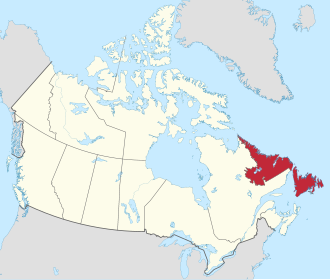
Newfoundland and Labrador is Canada's easternmost province, consisting of the rugged island of Newfoundland and the vast mainland region of Labrador. Famous for its dramatic coastal fjords, iceberg alley, unique dialects, and exceptionally friendly people, it is a land steeped in maritime tradition. Its capital and largest city is St. John's, one of the oldest European-founded settlements in North America.
Geography↑
Land and Water
The province is split into two distinct geographic areas: the island of Newfoundland, with its rocky headlines and glacial valleys, and Labrador on the mainland, characterized by ancient boreal forests, tundra, and mighty rushing rivers like the Churchill River. The coastline is heavily indented with thousands of bays, inlets, and dramatic sea cliffs facing the North Atlantic Ocean.
Location: Eastern Canada / Atlantic Canada
Geographic coordinates: 46°36′ N to 60°22′ N, 52°37′ W to 67°48′ W
Area: total: 156,453 sq mi (405,212 km2) | land: 143,053 sq mi (370,505 km2) | water: 13,400 sq mi (34,707 km2) | coastline: c. 10,500 miles (Atlantic Ocean)
Bordering Regions: Quebec, Nunavut (maritime)
Elevation extremes: lowest point: Atlantic Ocean sea level (0 ft) | highest point: Mount Caubvick at 5,420 ft (1,652 m)
Population↑
Demographics
Population: 540,500 (2026 estimate)
Largest City: St. John's: 115,000 (2026)
Age structure: 0-14 years: ~14.2% | 15-64 years: ~61.8% | 65 years and over: ~24.0% | Male: 49.2% | Female: 50.8%
Population growth rate: ~0.8% annually
Population density: 3.8 per sq mi (1.5 per sq km)
History↑
Vikings and Maritime Heritage
Long before European explorers arrived, Newfoundland and Labrador was home to Indigenous peoples including the Beothuk, Innu, Inuit, and Mi'kmaq. Around the year 1000 AD, Norse explorers led by Leif Erikson established a settlement at L'Anse aux Meadows on the northern tip of Newfoundland—the earliest verified European presence in North America. Following centuries as a British colony and independent Dominion, it joined Canada as its 10th province in 1949.
Economy↑
Energy, Mining, and Fisheries
The economy of Newfoundland and Labrador is driven heavily by offshore oil production, major hydroelectric generation (such as Churchill Falls), and mining operations in Labrador extracting iron ore and nickel. Traditional commercial fishing, aquaculture, forestry, and a booming tourism sector showcasing icebergs, whales, and historic sites also form vital parts of the economy.
Fun Facts↑
Did You Know?
L'Anse aux Meadows: This UNESCO World Heritage site contains the remains of an authentic 11th-century Viking settlement, proving that Norsemen reached North America centuries before Columbus.
Iceberg Alley: Every spring and summer, massive 10,000-year-old icebergs drifting down from Greenland pass right along the coast of Newfoundland, earning it the nickname "Iceberg Alley."
Own Time Zone: Newfoundland operates in its own unique time zone—Newfoundland Time—which is exactly 30 minutes ahead of Atlantic Standard Time!