Introduction↑
Background
Ontario is Canada's most populous province and the economic heartland of the nation. It is home to both Toronto, Canada's largest city and financial hub, and Ottawa, the federal capital of Canada. From the booming metropolitan Greater Toronto Area to millions of pristine northern lakes, dense boreal forests, and the world-famous Niagara Falls, Ontario combines bustling urban life with magnificent wilderness.
Geography↑
Land and Water
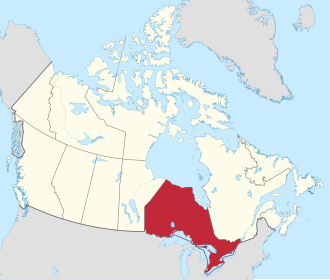
Ontario is massive in geographic scope, bordered by Hudson Bay and James Bay to the north, the province of Quebec to the east, the United States (including four of the Great Lakes) to the south, and Manitoba to the west. Its terrain spans the flat, swampy Hudson Bay Lowlands, the rugged rock and mineral-rich Canadian Shield in the center and north, and the fertile agricultural lowlands of the Great Lakes-St. Lawrence Valley in the south.
Location: Central Canada
Geographic coordinates: 41°41′ N to 56°51′ N, 74°20′ W to 95°9′ W
Area: total: 415,598 sq mi (1,076,395 km2) | land: 344,092 sq mi (891,190 km2) | water: 71,506 sq mi (185,205 km2) | coastline: c. 1,750 miles (Great Lakes / St. Lawrence Seaway)
Bordering Regions: Manitoba, Quebec, United States (Minnesota, Michigan, Ohio, Pennsylvania, New York)
Elevation extremes: lowest point: Atlantic Ocean sea level along the St. Lawrence River (245 ft / 75 m) | highest point: Ishpatina Ridge at 2,274 ft (693 m)
Population↑
Demographics
Population: 15,900,000 (2026 estimate)
Largest City: Toronto: 3,100,000 (Greater Toronto Area: ~7.0 million)
Age structure: 0-14 years: ~16.2% | 15-64 years: ~64.5% | 65 years and over: ~19.3% | Male: 49.0% | Female: 51.0%
Population growth rate: ~2.5% annually
Population density: 46.2 per sq mi (17.8 per sq km)
History↑
First Nations, Loyalists, and Confederation
For thousands of years prior to European contact, Ontario was inhabited by diverse Indigenous nations, including the Anishinaabe, Haudenosaunee, and Cree peoples. Following the American Revolution, thousands of United Empire Loyalists settled in the region. Originally designated as Upper Canada, it became a key province in the Canadian Confederation of 1867 alongside Quebec, Nova Scotia, and New Brunswick.
Economy↑
Finance, Manufacturing, and Tech
Ontario boasts the largest economy in Canada. Its major industries include financial services and banking (centered in Toronto), automobile manufacturing, technology and innovation, aerospace, mining, forestry, and agriculture. The province also produces significant hydroelectric power from massive installations along Niagara Falls and northern rivers.
Fun Facts↑
Did You Know?
Niagara Falls: Niagara Falls, located on the border between Ontario and New York, is one of the natural wonders of the world, discharging millions of gallons of water every minute.
Land of Lakes: Ontario contains over 250,000 freshwater lakes, holding about one-fifth of the world's fresh surface water supply.
The CN Tower: Standing at 1,815 feet (553.3 meters), Toronto's CN Tower was once the tallest freestanding structure in the world and remains an iconic symbol of Canada's skyline.