Introduction↑
Background
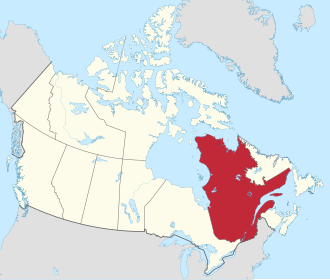
Quebec is Canada's largest province by total area and the heart of French-speaking culture in North America. Steeped in European history, it features stunning architecture, centuries-old fortifications, and vibrant modern cities. Its capital is historic Quebec City, while its largest metropolis is Montreal, one of the largest French-speaking cities in the world.
Geography↑
Land and Water
Quebec's vast geography stretches from the heavily populated St. Lawrence River valley in the south to the remote, rugged expanses of the Canadian Shield, Ungava Peninsula, and Arctic tundra in the north. It contains hundreds of thousands of freshwater lakes and rivers, including the mighty St. Lawrence River which serves as a major international shipping highway.
Location: Eastern / Central Canada
Geographic coordinates: 45°00′ N to 62°35′ N, 57°7′ W to 79°46′ W
Area: total: 595,391 sq mi (1,542,056 km2) | land: 444,442 sq mi (1,151,108 km2) | water: 150,949 sq mi (390,948 km2) | coastline: c. 8,500 miles (Gulf of St. Lawrence / Hudson Bay)
Bordering Regions: Ontario, New Brunswick, Newfoundland and Labrador, Nunavut (maritime), United States (New York, Vermont, New Hampshire, Maine)
Elevation extremes: lowest point: Atlantic Ocean sea level (0 ft) | highest point: Mount D'Iberville (Mont Caubvick) at 5,420 ft (1,652 m)
Population↑
Demographics
Population: 9,050,000 (2026 estimate)
Largest City: Montreal: 1,800,000 (Greater Montreal Area: ~4.4 million)
Age structure: 0-14 years: ~15.8% | 15-64 years: ~63.0% | 65 years and over: ~21.2% | Male: 49.5% | Female: 50.5%
Population growth rate: ~1.8% annually
Population density: 20.3 per sq mi (7.8 per sq km)
History↑
Indigenous Peoples and New France
For millennia, the region was inhabited by First Nations including the Haudenosaunee, Algonquin, Innu, and Inuit. French explorer Jacques Cartier arrived in 1534, and Samuel de Champlain founded Quebec City in 1608, establishing New France. After centuries of colonial changes, Quebec became one of the founding provinces of Canadian Confederation in 1867, retaining its unique civil law legal system and distinct cultural heritage.
Economy↑
Hydroelectric Power, Aerospace, and Tech
Quebec's economy is powered by vast renewable hydroelectric generation resources managed by Hydro-Québec, a thriving aerospace and high-tech software sector, mining (minerals and metals), forestry, and manufacturing. Tourism also brings millions of visitors to experience its rich European-style history and winter carnivals.
Fun Facts↑
Did You Know?
Old Quebec: Old Quebec is the only fortified North American city north of Mexico whose historic walls and ramparts still remain intact today, earning it UNESCO World Heritage status.
Maple Syrup Capital: Quebec produces the vast majority of the world's maple syrup, accounting for roughly 70% of global production!
French Language: French is the official language of Quebec, and over 80% of the province's population speaks French as their primary language.