Introduction↑
Background
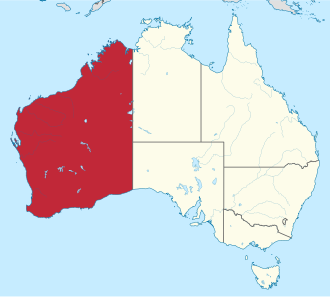
Western Australia (WA) is Australia's largest state, occupying the entire western third of the Australian continent. Covering a massive geographic expanse of over one million square miles, WA is renowned for its vast desert wilderness, mineral wealth, pristine Indian Ocean coastline, and unique flora and fauna. The capital city is Perth, one of the most isolated major metropolitan cities in the world, positioned between the Indian Ocean and the Darling Scarp.
Geography↑
Land and Water
The geography of Western Australia is dominated by the ancient Yilgarn and Pilbara cratons, forming vast arid plateaus, red sandstone gorges, and sweeping deserts like the Great Sandy and Victoria Deserts. To the north lies the rugged Kimberley region, while the southwest features Mediterranean-style coastal plains and ancient Karri forests. Key coastal features include Ningaloo Reef and the world-famous beaches along the Indian Ocean.
Location: Western Australia
Geographic coordinates: 13° S to 35° S, 112° E to 129° E
Area: total: 976,790 sq mi (2,527,013 sq km) | land: 974,270 sq mi | water: 2,520 sq mi | coastline: 12,887 miles (20,740 km)
Bordering Regions: Northern Territory, South Australia
Elevation extremes: lowest point: Indian Ocean sea level (0 ft) | highest point: Mount Meharry 4,101 ft (1,249 m)
Population↑
Demographics
Population: 2,951,600 (2026 estimate)
Largest City: Perth: 2,309,300 (Greater Perth area)
Age structure: 0-14 years: ~18.8% | 15-64 years: ~65.6% | 65 years and over: ~15.6% | Male: 50.2% | Female: 49.8%
Population growth rate: ~2.3% annually
Population density: 3.0 per sq mi (1.17 per sq km)
History↑
Indigenous Heritage and Swan River Colony
Aboriginal Australians, including the Noongar, Noongar-Yamatji, and Martu peoples, have inhabited Western Australia for over 50,000 years. Dutch navigator Dirk Hartog was among the first Europeans to land on the coast in 1616. Britain established the Swan River Colony in 1829 at present-day Perth. Gold discoveries in Kalgoorlie and Coolgardie during the 1890s triggered a historic gold rush, accelerating population growth before Western Australia joined the Commonwealth in 1901.
Economy↑
Mining, Energy, and Agriculture
Western Australia's economy is an export powerhouse, primarily driven by iron ore mining in the Pilbara, liquefied natural gas (LNG), gold, lithium, and rare earth minerals. Agriculture is another major contributor, with large-scale wheat farming, sheep grazing, and world-class winemaking in the Margaret River region.
Fun Facts↑
Did You Know?
Super Isolated City: Perth is geographically closer to Jakarta, Indonesia, than it is to Australia's national capital, Canberra!
Friendly Quokkas: Rottnest Island, located just off the coast of Perth, is home to the quokka—a small marsupial famous worldwide as the "world's happiest animal" due to its natural smiling expression.
Giant Natural Wonders: Ningaloo Reef along WA's coast is one of the few places on Earth where visitors can swim alongside giant, harmless whale sharks in their natural habitat.