Introduction↑
Background
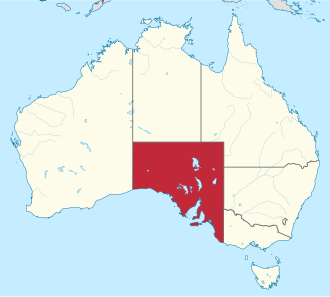
South Australia (SA) is centrally located on the southern coast of the Australian continent, known for its arid Outback expanse, rugged gulf coasts, and world-class wine regions. Unlike most other Australian states, South Australia was established as a freely settled British province rather than a convict colony. The capital city is Adelaide, a carefully planned coastal city celebrated for its parks, culture, and arts festivals.
Geography↑
Land and Water
The geography of South Australia features some of the driest parts of the continent, including the vast salt flats of Lake Eyre (Kati Thanda)—the lowest point in Australia. The state is bisected by the lower reaches of the Murray River and features two major southern gulfs (Spencer Gulf and Gulf St Vincent). Mountain ranges like the Mount Lofty and Flinders Ranges run north from Adelaide into the arid interior.
Location: Central and Southern Australia
Geographic coordinates: 26° S to 38° S, 129° E to 141° E
Area: total: 379,725 sq mi (983,482 sq km) | land: 379,725 sq mi | water: surface water varies significantly with dry salt lakes | coastline: 3,137 miles (5,050 km)
Bordering Regions: Western Australia, Northern Territory, Queensland, New South Wales, Victoria
Elevation extremes: lowest point: Lake Eyre -49 ft (-15 m) below sea level | highest point: Mount Woodroffe 4,724 ft (1,435 m)
Population↑
Demographics
Population: 1,865,400 (2026 estimate)
Largest City: Adelaide: 1,418,450 (Greater Adelaide area)
Age structure: 0-14 years: ~17.2% | 15-64 years: ~63.1% | 65 years and over: ~19.7% | Male: 49.5% | Female: 50.5%
Population growth rate: ~1.2% annually
Population density: 4.9 per sq mi (1.9 per sq km)
History↑
Indigenous Heritage and Free Settlement
Aboriginal nations such as the Kaurna, Adnyamathanha, and Pitjantjatjara have cared for South Australia's lands for over 50,000 years. British maritime exploration was recorded by Matthew Flinders and Nicolas Baudin in 1802. Founded in 1836 based on the theories of Edward Gibbon Wakefield, South Australia was unique as a planned colony for free immigrants without penal convicts. It federated into the Commonwealth of Australia in 1901.
Economy↑
Manufacturing, Wine, and Defense
South Australia's economy is diverse, anchored by high-tech manufacturing, defense shipbuilding, renewable energy production, and agriculture. The state is internationally renowned for producing world-class wines in regions like the Barossa Valley, McLaren Vale, and Clare Valley, alongside mining operations yielding copper, uranium, and mineral sands.
Fun Facts↑
Did You Know?
The Opal Capital: The remote South Australian town of Coober Pedy is known as the opal capital of the world, where many residents live in underground homes ("dugouts") to escape the extreme desert heat!
Wildlife Haven: Kangaroo Island off the coast of SA is a sanctuary where kangaroos, koalas, sea lions, and penguins thrive in protected natural habitats.
Submerged Salt Lake: Lake Eyre is Australia's largest salt lake, which only fills with water once every few decades when rare desert monsoons occur.