Introduction↑
Background
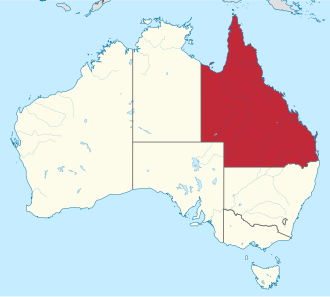
Queensland, famously known as the "Sunshine State," occupies the entire northeastern corner of the Australian continent. It is Australia's second-largest state by area and boasts world-renowned tropical natural wonders, including the Great Barrier Reef and ancient Daintree Rainforest. The capital city is Brisbane, a vibrant, fast-growing riverside metropolis in the state's southeast.
Geography↑
Land and Water
Queensland's geography ranges from sun-drenched coastal beaches and tropical islands to the rich agricultural lands of the Darling Downs and the semi-arid expanses of the interior Outback. Off its northeastern coast lies the Coral Sea and the Great Barrier Reef—the world's largest coral reef system, stretching over 1,400 miles.
Location: Northeastern Australia
Geographic coordinates: 10° S to 29° S, 138° E to 153° E
Area: total: 668,207 sq mi (1,730,648 sq km) | land: 659,183 sq mi | water: 9,024 sq mi | coastline: 4,349 miles (6,973 km)
Bordering Regions: New South Wales, South Australia, Northern Territory
Elevation extremes: lowest point: Pacific Ocean / Coral Sea sea level (0 ft) | highest point: Mount Bartle Frere 5,285 ft (1,611 m)
Population↑
Demographics
Population: 5,556,192 (2026 estimate)
Largest City: Brisbane: 2,676,985 (Greater Brisbane area)
Age structure: 0-14 years: ~18.5% | 15-64 years: ~63.8% | 65 years and over: ~17.7% | Male: 49.6% | Female: 50.4%
Population growth rate: ~1.9% annually
Population density: 8.3 per sq mi (3.2 per sq km)
History↑
Indigenous Heritage and Settlement
Aboriginal Australians and Torres Strait Islander peoples have lived in Queensland for tens of thousands of years, comprising numerous distinct language groups and complex cultures tied closely to both the coastal reefs and the interior lands. European exploration was spearheaded by Lieutenant James Cook, who mapped the eastern coast in 1770. Originally established as the Moreton Bay penal colony for repeat offenders in 1824, Queensland separated from New South Wales to become a self-governing colony in 1859, later joining the Australian Federation in 1901.
Economy↑
Tourism and Natural Resources
Queensland's economy is fueled by a booming tourism sector centered around the Gold Coast, Sunshine Coast, and the Great Barrier Reef. In addition to tourism, the state is an economic powerhouse in agriculture (producing sugarcane, beef, and tropical fruits) and mining, with massive exports of coal, bauxite, copper, and natural gas from the Bowen Basin.
Fun Facts↑
Did You Know?
Visible from Space: The Great Barrier Reef in Queensland is so massive that it is the only living structure on Earth that can be clearly seen from outer space!
Ancient Rainforests: The Daintree Rainforest in far north Queensland is estimated to be over 130 million years old, making it one of the oldest surviving rainforests anywhere on the planet.
No Daylight Saving: Unlike most of southeastern Australia, Queensland does not observe Daylight Saving Time, keeping its clocks on Australian Eastern Standard Time (AEST) all year round.